Loading…

The four levels of chocolate customisation, what each costs, why MOQs exist, the real lead-time calendar, and the design rules that stop artwork being rejected.

Faaro Editorial
Editor
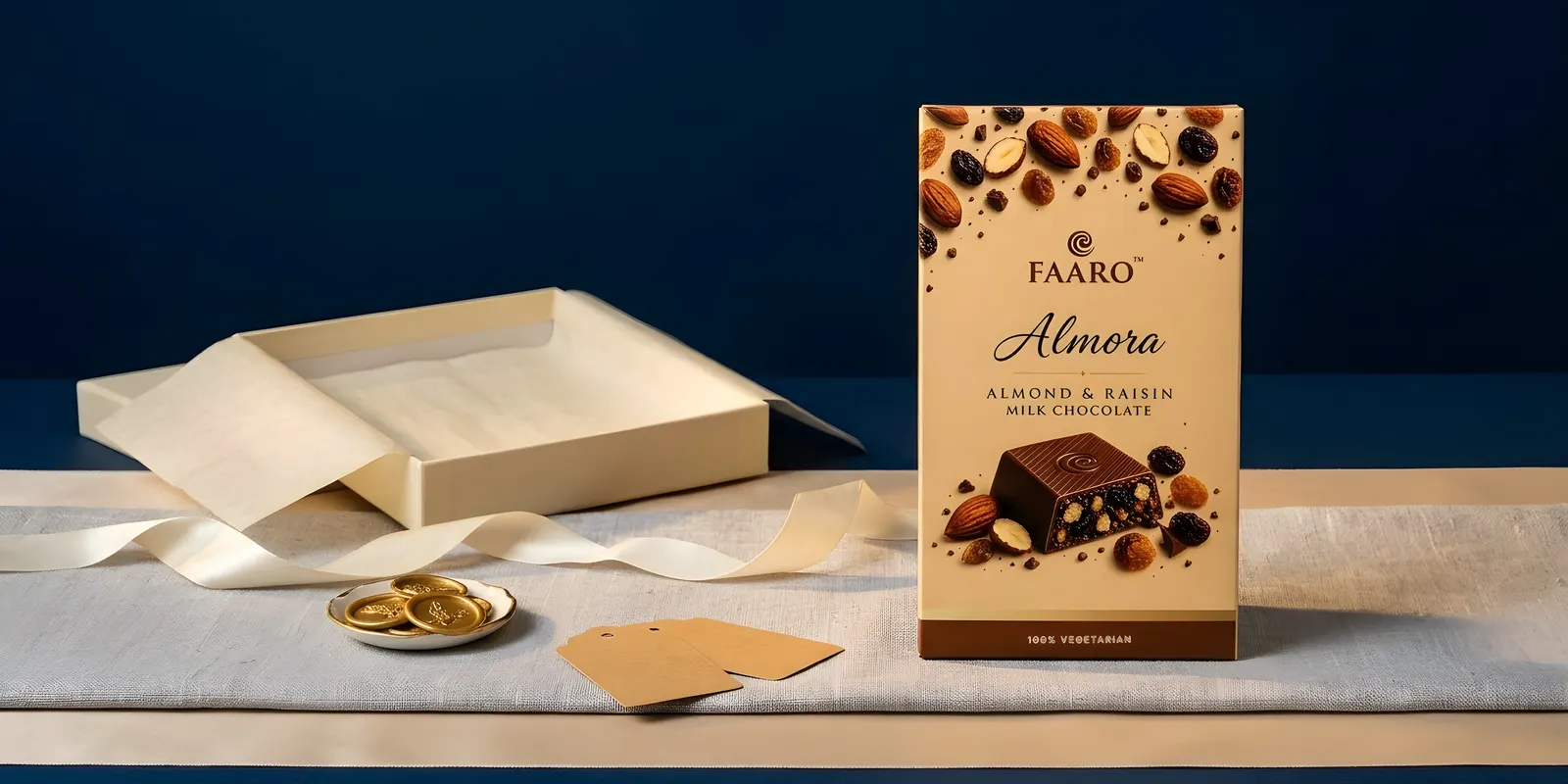
Somebody has asked you for four hundred wedding favours with the couple's names on them, or two hundred Diwali gifts carrying your company's logo, and you have discovered the same thing everyone discovers: it is easy to find someone who will sell you chocolate, and surprisingly hard to find anyone who will explain how customising it actually works.
This is that explanation. What can and cannot be personalised on a chocolate gift, what each level of customisation costs you in money and in time, what the minimum order quantities are for and why they exist, the design rules that will get your artwork rejected, and the brief to send so you get a usable quote on the first email rather than the fourth.
Almost every disappointing quote comes from a mismatch here: the customer is imagining level four and the supplier is quoting level one. There are four distinct things people mean, and they differ by an order of magnitude in cost.
A paper band or sleeve wraps around the existing bar, carrying names, a date, a message, a logo or a QR code. The chocolate and its own packaging are untouched, which is why this is the fastest and cheapest route and why it has the lowest minimum order. For a wedding favour or a Diwali desk gift, it is usually all the personalisation anyone actually notices.
Standard bars are placed inside a rigid box, drawer box or hamper printed with your artwork. You get a much larger printable area, a proper unboxing moment and the ability to mix products. It costs more than a sleeve because the box is a manufactured item with its own die and set-up, but it also feels several times more expensive to receive.
The bar's own carton or wrapper is reprinted with your design. This is genuine bespoke packaging and it looks it. It is also the point where you inherit the full weight of food labelling law, because that pack is now the legal label — every mandatory declaration has to be on it, correctly, in the right sizes. Minimums are considerably higher and lead times longer, because you are commissioning a print run rather than a wrap.
You choose which flavours go in, in what arrangement, inside a box built and printed to your brief, often with an insert tray, a card and a ribbon. This is what most people are actually picturing when they say "custom chocolate gift". It is the most expensive per unit and the most impressive in the hand, and it is worth it for a small, high-value list — clients, senior staff, close family — rather than for a mass send.
A pattern that works for almost everybody: level 4 for the top fifty names on the list, level 1 or 2 for the other four hundred. The people who receive the sleeve never see the bespoke box, and you have spent your budget where it is noticed.
Printing is dominated by set-up rather than by material. A print run needs artwork prepared, plates or dies made and a machine set up and test-run before a single usable unit comes off it. That cost is fixed, so it is spread across however many units you order. Two hundred units carry the whole of it; two thousand barely feel it.
Which is why a minimum order quantity is not a supplier being difficult. It is the point below which the set-up cost per unit becomes larger than the product, and a quote for fifty personalised boxes will look absurd for exactly that reason. If your list is genuinely small, the right answer is usually a level-1 sleeve on a standard gift box rather than a bespoke print run.
Faaro quotes on your actual quantity, format and finish rather than publishing a rate card, because a number that ignores those three things would be wrong for almost everyone who read it. Tell us the quantity and the date and you will get a real figure.
The single most common reason a personalised chocolate order goes wrong is that it was started three weeks too late. A workable calendar for a printed order looks like this.
For Diwali, work backwards from the date you want gifts in people's hands, not the festival itself — most corporate gifts need to land one to two weeks early. In practice that means briefing in August or early September. Wedding favours should be commissioned as soon as the guest count is stable.
If your requirement is bulk rather than bespoke — large volumes of standard packs at wholesale rates — that is a different conversation, and we have written it up in bulk chocolate for weddings and events in South India and corporate Diwali chocolate gifting in bulk.
India hosts somewhere between nine and eleven million weddings a year, and the peak season alone moves several lakh crore through the economy. Chocolate has taken a growing share of the favour and return-gift budget for a straightforward reason: it suits everyone, it needs no plate, it travels in a car boot, and it does not have to be eaten today.
Chocolate travels far better than mithai in Indian conditions and keeps for months rather than days, which is the practical reason couples increasingly choose it. We have written about that shift in why South Indian couples are choosing chocolate over sweets for return gifts.
India's corporate gifting market is now estimated at well over ₹25,000 crore, and it has moved decisively towards personalisation — buyers increasingly want something that carries the company's identity rather than a generic hamper with a card taped to it. Packaging has become the differentiator, with a large majority of buyers saying packaging and originality directly influence what they choose.
Four rules save more reprints than everything else combined.
One more, learned the hard way by everybody at least once: proofread the proof out loud, and get a second person to do it too. A misspelt name on four hundred wedding favours cannot be fixed on the day.
Six lines. Send these and a supplier can price the job immediately instead of asking six follow-up questions.
Faaro makes its chocolate at our own facility in Kannur, Kerala, which is what makes customisation practical rather than theoretical — packing, printing and dispatch sit in the same place, so a personalised order does not have to be shipped between three vendors before it reaches you.
To start, send us your brief with the six lines above, or message us on WhatsApp. If your order is large enough to be a wholesale conversation as well as a gifting one, the distributor and bulk page has the full catalogue.
Yes. The most common and cost-effective route is a printed sleeve, band or outer box carrying your logo, names or message wrapped around a standard bar. Fully custom artwork printed on the bar's own pack is also possible at higher quantities, and that route requires the mandatory food declarations — ingredients, allergens, net weight, FSSAI and manufacturer details, batch and best-before — to be carried on the design.
It depends entirely on which level of customisation you choose. A printed sleeve or band around a standard pack has the lowest minimum because nothing about the product changes. A fully printed custom carton has a much higher one, because a print run has fixed set-up costs for plates, dies and machine set-up that only make sense across a reasonable quantity. Send us your quantity and we will tell you which level it supports.
Budget four to six weeks from brief to delivery for anything printed: a week for the brief and quote, a week for artwork and proofing, two weeks for printing and production, and a week for assembly, checking and dispatch, plus a buffer. In the run-up to Diwali and during peak wedding season, start earlier — printers and packers fill up, and the calendar tightens for everyone.
They are one of the strongest options, because chocolate suits every recipient regardless of dietary preference, needs no serving, travels well and keeps for months. India's corporate gifting market is now valued at over ₹25,000 crore and has shifted firmly towards personalised, branded packaging. The practical constraint is timing: brief in August or early September so gifts land a week or two before the festival.
Yes. A curated assortment is the top level of customisation — you pick the flavours, the arrangement and the box, and we build it to that brief. It costs more per unit than a standard box because it is assembled by hand, so it is usually best reserved for a shorter, higher-value list, with a simpler printed sleeve or box for the wider send.
Yes. Faaro manufactures and packs in Kannur, Kerala and dispatches across India, with the shortest lead times across South India — Kerala, Tamil Nadu, Karnataka, Telangana and Andhra Pradesh. Tell us the delivery city and date in your brief and we will confirm the dispatch schedule with the quote.
Personalised chocolate is one of the few gifts that is genuinely improved by being thought about in advance. Decide the level, write the six-line brief, leave the buffer week, and the rest is straightforward.
Share this article
Keep Reading
Premium chocolate bars are replacing the traditional sweet box as the South Indian wedding return gift of choice. Here is why — and how to choose the right bars for favours at scale.
Planning corporate Diwali or festival gifts? A wholesale guide for South Indian companies — bulk chocolate hampers, MOQ, lead times, GST billing and how to order from Faaro.
Planning a wedding or event? A wholesale guide to bulk chocolate favours, hampers and return gifts in South India — what to order, quantities, lead times and pricing from Faaro.
Couverture uses cocoa butter; compound uses vegetable fat. What FSSAI actually requires, six ways to tell the two apart on an Indian shelf, and how to read a chocolate label.